
The Opening Ceremony of the Olympic Games will take place on 6 February 2026 at 8 p.m. at the San Siro Stadium.
MILANO CORTINA 2026 OLYMPICS - TORCHES AND RELAY CAULDRON
From torch to relay cauldron, designed by CRA-Carlo Ratti Associati, one flame unites cities across Italy on its road to the 2026 Olympics.
Designed around fire, the Milano Cortina 2026 Olympic Torches place the flame—its visibility and vitality—at the heart of the project. Creators Eni, Premium Partner of Fondazione Milano Cortina 2026 Olympic and Paralympic Winter Games, in collaboration with Versalis, Official Supporter of the Games, entrusted the design development to CRA-Carlo Ratti Associati, while Cavagna Group is responsible for the engineering and production of the torches and their components. The torches bring together design, engineering, and material innovation to support the flame without overshadowing it. The Milano Cortina 2026 Olympic Winter Games will take place from February 6 to 22, 2026, and the Paralympic Winter Games from March 6 to 15, 2026.
The mini-cauldron, also designed, engineered, and produced by CRA-Carlo Ratti Associati, has been developed as a mobile relay cauldron for selected city celebrations along the route. Commissioned by Eni and developed in collaboration with Versalis, it accompanies the torch relay during approximately 80 public events. Its sculpted blade geometry creates a Venturi effect that shapes the flame into a vertical vortex, elongating and stabilizing it without increasing gas consumption. The system remains fully operational down to extreme conditions of −20°C. The blades share the same PVD finish as the torch, maintaining a coherent visual language while translating the same combustion logic to a collective, ceremonial scale.
“We wanted to strip away the superfluous,” said Carlo Ratti, Founding Partner of CRA-Carlo Ratti Associati and Director of the MIT Senseable City Lab. “The brief was clear: the flame had to be the protagonist.” The torch is conceived from the inside out, starting from the burner rather than from an external form. Every element is shaped around a high-performance combustion system, keeping only what is necessary to support it.
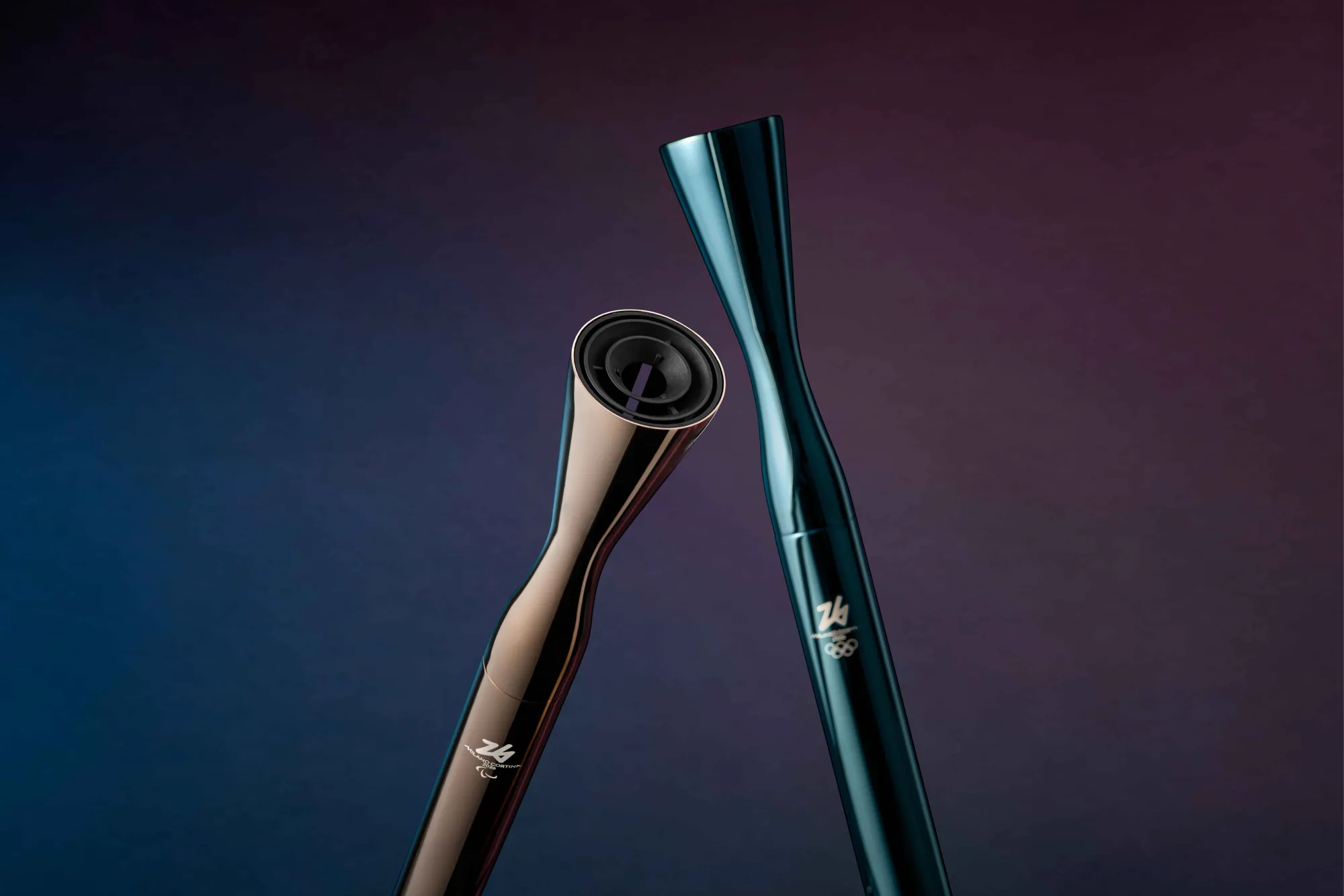
For the first time in Olympic design, the internal mechanism that ignites the flame is made visible. A longitudinal opening runs along the body of the torch, allowing the burner and the moment of ignition to be observed in real time. Developed with Cavagna Group, the burner is powered by bio-LPG produced from 100% renewable feedstocks, including used cooking oils and agro-industrial residues, at Eni’s Enilive biorefinery in Sicily. It produces a stable, warm yellow flame, chosen for visibility in daylight and broadcast conditions, and recalls the original fire lit in Olympia, Greece.
The torch uses advanced materials to support the flame through changing environments. The main body is finished with a PVD coating, a high-performance, heat-resistant, and durable film engineered for repeated ignition cycles and winter conditions. Two versions were created, one for the Olympic Winter Games and one for the Paralympic Winter Games. Both share the same reflective, iridescent finish but differ in color: blue-green hues for the Olympic torch and bronze tones for the Paralympic torch. Despite their distinct tones, the surfaces act as mirrors, continuously reflecting the surrounding environment. In low-light conditions, the body becomes almost invisible, and the flame appears to float in mid-air.
The structure is primarily made from recycled aluminium and brass and weighs approximately 1,060 grams (with the gas canister empty). Each torch is designed for reuse: the burner can be refilled up to ten times, reducing the total number of torches produced to just 1,500.
“The biggest challenge was designing not just an object, but a phenomenon,” added Ratti. “Fire changes with motion, wind, altitude, and temperature. We had to start from that instability and work backwards, designing from the inside out around something alive, while ensuring it performs flawlessly when the world is watching.”
The torch resonates with a tradition of clarity and restrained design. “It is impossible not to think of Sori Yanagi’s torch for the 1964 Tokyo Games,” commented Ratti. “That same spirit guided our work: to subtract, simplify, and let the flame speak.” Unlike many of its predecessors, this torch invites us to look through it, toward the flame, and the shared ritual it represents. “The most powerful symbols are the ones that know when to step back,” concluded Ratti.