
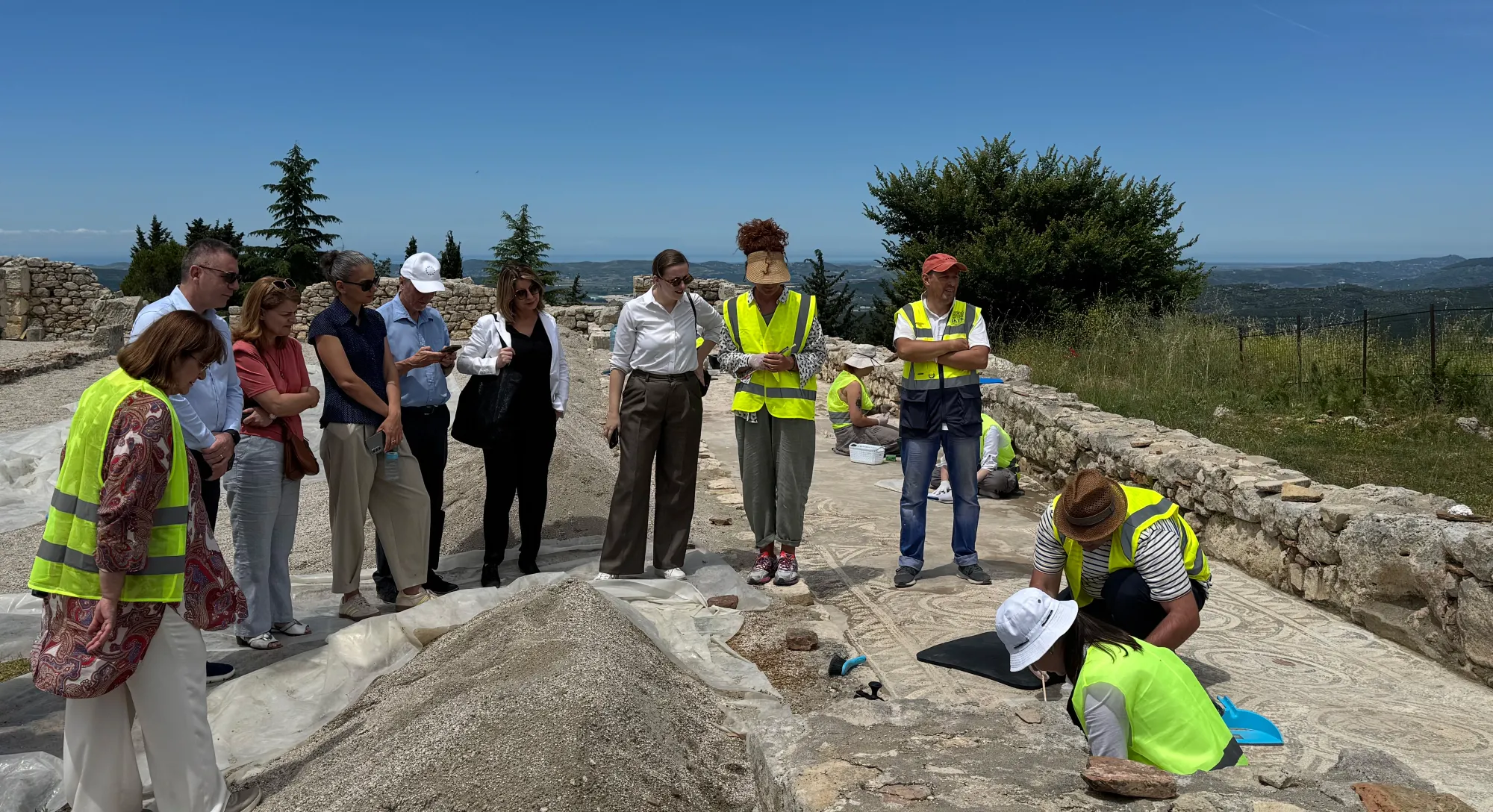
As part of the Capacity building project for the Bylis and Klos Archaeological Management Plan, funded by the European Union (EU for Economic Development - Tourism-led local economic development, with a focus on Cultural Heritage, Chapter 3A) and signed between the ABC department of the Politecnico di Milano and AICS Tirana, the SCUOLA DI CANTIERE activity was carried out within the Archaeological Park of Bylis and Klos, in Albania.
The project, which took place from May 25th to June 5th, aimed to conserve the mosaics and monumental remains of the archaeological site of Bylis and Klos, discovered in various Byzantine basilicas, through the SCUOLA CANTIERE pilot project. The initiative, which actively involved a diverse group of people: a dozen young students from the archaeology departments of the University of Tirana (UT), restorers, and Albanian craftsmen; had the primary objective of transmitting not only the most modern conservation techniques compatible with the historical material present, but also, and above all, the historical and artistic value of the site for the local community.
Byzantine mosaic floors
Specifically, the project involved coordinating the in situ conservation of the Byzantine mosaic floors discovered inside Basilica B. The work began in the last week of May and continued for the next 14 days, culminating in the presentation of the work completed and the results achieved to the local political authorities.
The supervised interventions followed rigorous scientific standards, focusing in particular on two methodological aspects:
- Gap management: the perimeter edges were secured to prevent the detachment and loss of mosaic tiles, applying strictly reversible integration and protection methods.
- Mosaic consolidation and cleaning: hydraulic lime-based mortars were applied manually, using small spatulas, directly on site, ensuring full chemical and physical compatibility with the existing historical substrates.
During the construction site, a cutting-edge technique in mosaic restoration was also implemented: this methodology involves the controlled rehydration of the mortar once it has been placed, allowing operators to extend the work time and operate on a structurally more malleable and precise area.
Digitization of the archaeological park
At the same time, the results obtained through the digitization of the archaeological park using remote-controlled drones were presented to the dignitaries present, which enabled the creation of a georeferenced and searchable 3D model of the area. This step is extremely important because, first and foremost, it provides reliable documentation of the current state of Bylis for local operators. At the same time, it allows for mapping and assessing potential changes over time due to atmospheric agents and external phenomena on the remains, in order to implement new management strategies for the entire archaeological site.
The event saw the active participation of:
- Professor Nora Lombardini, project coordinator (DABC - Politecnico di Milano),
- Professor Lorenzo Cantini (DABC - Politecnico di Milano),
- Professor Lorenc Bejko (UT),
- Professor Iris Pojani (UT).
The final day also saw the meeting of the Steering Committee, with the participation of:
- Ms. Lira Pipa - Deputy Minister, Ministry of Tourism, Culture and Sport (MTKS),
- Mr. Andrea Ferrero - Head of Section, Sustainable Economic and Social Development Section,
- Ms. Entela Sulka - Programme Officer, Transport, Tourism/Culture and Telecommunication,
- Ms. Letizia Fischioni - Acting Director of AICS Tirana,
- Mr. Ilir Parangoni - AICS Tirana, Project Team Leader.