
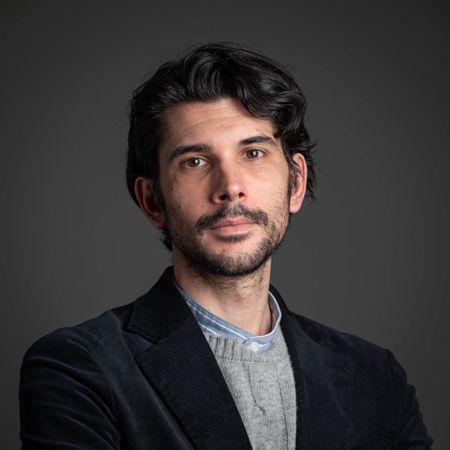
Korolija Aleksa
Researcher
He conducts research and teaching in the field of architectural design. His interests include composition at various scales, from building design to urban planning, understood as the definition of spatial arrangements and places of civil coexistence. He combines theoretical and critical research with project-based experimentation, including through participation in national and international competitions and training programs (workshops, summer schools). In his teaching, he promotes an approach to contemporary design based on methodological rigor and critical awareness built on multidisciplinary foundations.
Career
He graduated from the Polytechnic University of Milan in 2012 with a thesis in Urban Design. In 2017, he received a PhD in Architecture, Urban Planning, and Conservation of Living Spaces and Landscape (XXVIII cycle). Between 2017 and 2020, he was a research fellow at the Polytechnic University of Milan as part of the European project MODSCAPES – Modernist reinventions of the rural landscape, focusing his research on the formal and social impact of infrastructure networks in rural contexts. He is currently a Research Fellow (RTD-A) at the Department of Architecture, Construction Engineering, and Built Environment (DABC) and teaches at the AUIC School of the Polytechnic University of Milan, where he teaches Architectural Design.
Research
His research focuses on two lines of research. The first focuses on the context of the former Yugoslavia and examines, from a historical-critical perspective, the architecture and urban planning of the socialist and post-socialist periods, with a particular focus on memorial architecture and commemorative devices (monuments and memorials), in their historical and contemporary forms. In this context, monuments and memorials are considered primarily representative architecture, in which spatial, formal, and figurative components play a decisive role over functional ones, serving as tools for constructing and transmitting public memory and for processing collective events and traumas in space. The second line of research concerns the modernization processes of the rural landscape, with reference to the transformation of reclaimed landscapes and the role of technical-functional infrastructure and architecture. These structures are analyzed both for the operational logics that determine them and for the morphological and figurative effects they produce at the scale of the settlement and landscape. More recently, he has been working on experiential teaching and learning methods applied to architectural composition.
Selected Publications
Korolija, A. (2023) "Di pietra e di piuma. Bogdan Bogdanovic e lo spazio memoriale", Academia University Press, Torino.
Korolija, A. (2025) "Esperimenti di pedagogia della forma", Stoa Journal, n.12, pp.48-59.
Korolija, A. (2024) "Urban ensemble as decoded and conceived in the texts by Dušan Grabrijan and Bogdan Bogdanović", Docomomo Journal n.72, pp.56-64. 10.52200/docomomo.72.07
Korolija, A. Pallini, C. (2025) “Landscapes of nomadism into rural modernisation schemes: instant townscapes and heritage features”, in Sezer, Ö. Egbers, V. (eds.) The Making of Identity through Rural Space: Scenarios, Experiences and Contestations, Birkhauser, pp. 33-56.
Korolija, A. (2022) “Architetture del tuttotondo, Le torri dell’acqua nelle città di fondazione dell’Agro Pontino.”, in FAMagazine, Ricerche E Progetti sull’architettura e la Città, n. 62-63, pp. 38-52.
Korolija, A. (2022) “Belgrade’s Reconstruction: identifying grafting points”, in: Terzoni, M. Lombardini, N. (eds.) Heritage without frontiers. Knowledge and protection of cultural heritage on the occasion of the 50th anniversary of the unesco world heritage convention and the 35th anniversary of the Erasmus student mobility actions, pp. 197-212, Aracne, Roma.
Research projects
MODSCAPES
Project details